
When purchasing diamond stud earrings, the best practice is to focus on cut quality and secure settings before carat weight, to match the metal to your skin tone, and to buy from a jeweler who provides a grading report and warranty. Carat weight is less significant than most buyers think. Studs are simple in form, and that’s why the details matter so much. A poorly matched pair, a weak setting or the wrong metal tone can leave an otherwise nice diamond looking flat or feeling fragile. Here are seven things worth getting right before you buy.
Size is less important than cut quality in the case of diamond stud earrings. A well-cut .75 carat stone will sparkle more and look brighter across the room than a poorly cut 1 carat stone. That brilliance is basically how “quality” translates to other people. Most people see studs from afar, not like a close-up engagement ring. If you are working with a budget, it is almost always better to go down a little in carat weight and up a little in cut grade.
This is the tip most buyers skip, and it’s the one that affects how the earrings look every single day. Diamonds are graded individually, but studs are worn as a matched pair – so ask your jeweler whether the two stones are matched for color, clarity, and cut, not just carat weight. A pair with a noticeable color or brightness mismatch will be obvious side by side, even if each stone has a good grade on paper.
Diamond earrings take a beating on a daily basis, more so than almost any other piece of jewelry – constantly being brushed against hair, pillows, phones and clothing. A four-prong or six-prong basket setting is the standard for a reason; it holds the diamond well enough that it allows light to come in from many angles. A bezel setting is when a diamond is surrounded by a thin band of metal around all of its edges. They lose some luster but gain protection. They’re a great choice if you’re active or lose jewelry easily. Whatever setting you choose, be certain the prongs are straight and the backing (push-back, screw-back or lever-back) is tight, not loose.
Usually, diamond earrings are set in white gold, yellow gold, rose gold and platinum. The right one will depend on the skin tone and the way the earrings will be worn. If your skin has cooler, pink or blue undertones, you’ll generally look best in white gold or platinum; if your undertone is warmer, golden or olive, you’ll look best in yellow or rose gold. Platinum is the most hypoallergenic and tarnish-resistant because earrings are in constant contact with the skin and hair oils.
Image ALT Text: stud earrings
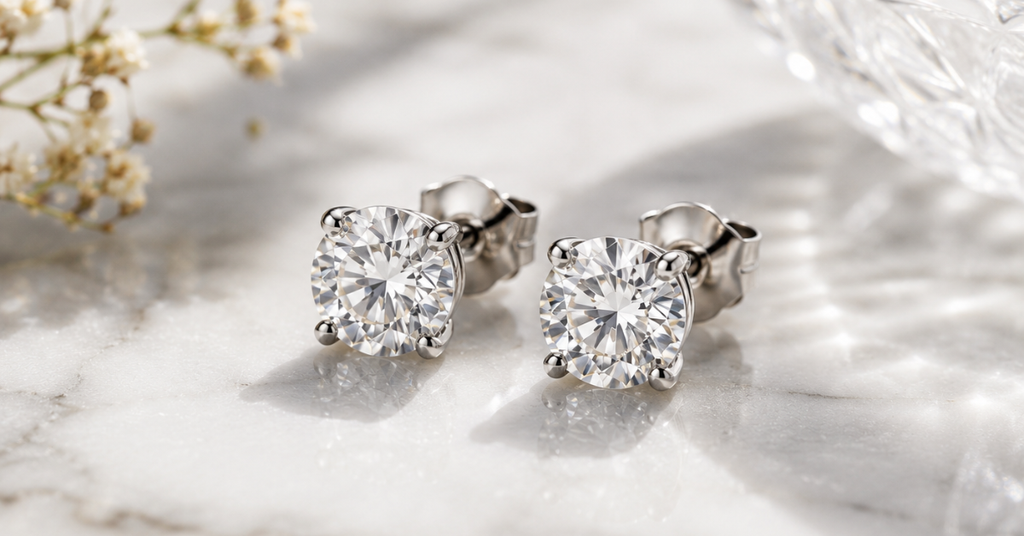
The 4 Cs – cut, color, clarity, and carat – still apply to stud earrings, but the priority order shifts compared to a solitaire ring. Because earrings are typically smaller stones viewed at a distance, minor clarity inclusions (VS2 or SI1, for example) are far less noticeable than they would be in a large center diamond, so you can often save money here without a visible trade-off. Color grades in the near-colorless range (G–I) also tend to look bright and white in earring settings, meaning you don’t usually need to pay for the top of the color scale to get a clean, white look.
Lab-grown diamonds are chemically, physically, and optically identical to natural diamonds, but typically cost 30–40% less for the same size and quality. For stud earrings specifically – where two matched stones are needed rather than one – that price difference can mean the ability to size up, upgrade cut quality, or match a pair more precisely for the same budget. Neither option is objectively “better”; it comes down to personal preference and whether resale value or natural rarity matters to you.
A good jeweler will provide you with a grading report – from GIA or AGS for natural diamonds or a similar lab report for lab-grown stones – that will verify the cut, color, clarity and carat of each earring. This is even more important with earrings than people realize, because if they are a matched pair without paperwork, it is hard to prove that you are getting what you paid for. Ask about the backing warranty, too, and whether the jeweler will do prong checks or cleaning for free. Loose prongs are the number one reason for a lost diamond and a quick annual check prevents it.
Image ALT Text: stud earrings for girls
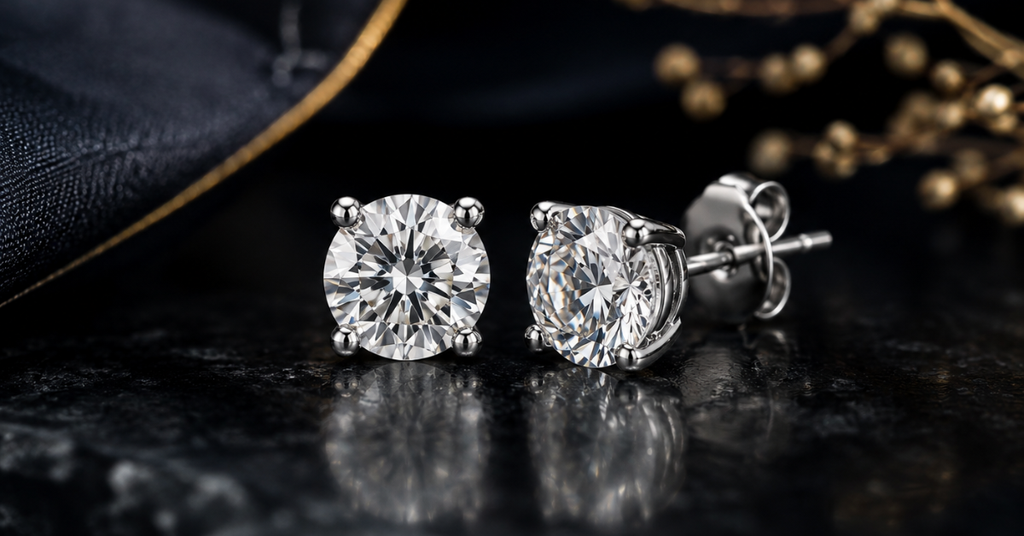
The classic round or princess cut solitaire stud is the most popular option and can be worn everyday or dressed up. A halo of smaller stones around the center stone makes the diamond seem larger for less. If you’re looking for something a little different from the classic single stone style, then three-stone or cluster studs are a more modern choice. Whatever your style, the same basics apply all across the board: quality of cut, matched pairing, secure setting.
Matching a pair of diamonds well takes an experienced eye and access to enough inventory to actually compare stones side by side – something a photo on a website can’t replicate. Clifton Jewelers offers in-person pairing and grading guidance, so you can see how two diamonds look together before committing rather than relying on paper specs alone. Their team can also walk through setting options and metal choices based on how you’ll actually wear the earrings day to day, backed by certification and aftercare support once you’ve made your choice. For a purchase where the details are what separate a great pair from an average one, that hands-on comparison is worth more than shopping by spec sheet alone.